Pluto
Dwarf planet · Kuiper Belt objectPluto imagery
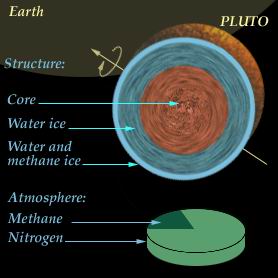
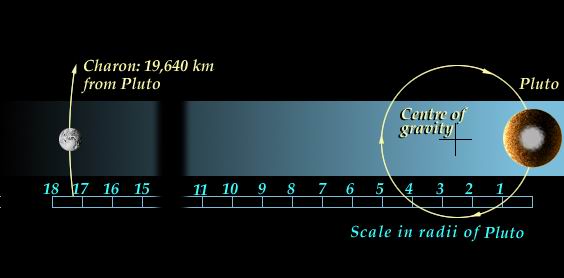
Dwarf planet data
| Classification | Dwarf planet; Kuiper Belt object |
| Mean distance from Sun | 3.7 billion miles (5.9 billion km / about 39 AU) |
| Distance range from Sun | about 30–49.3 AU |
| Orbital period | about 248 Earth years |
| Axial rotation | about 153 hours (6.4 Earth days), retrograde |
| Axial tilt | about 57° |
| Equatorial diameter | 1,477 miles (2,377 km) |
| Mass (Earth = 1) | 0.00218 |
| Density | about 1.85 g/cm³ |
| Surface gravity (Earth = 1) | about 0.063 |
| Typical surface temperature | about −226 °C to −240 °C |
| Atmosphere | Very thin; mainly nitrogen with methane and carbon monoxide |
| Known moons | 5 — Charon, Styx, Nix, Kerberos and Hydra |
| Known rings | None |
Pluto commentary
Pluto
Pluto spent most of the twentieth century as the ninth planet and then, in 2006, acquired the rather more bureaucratic title of dwarf planet. The change of label did not make Pluto any less interesting. If anything, the New Horizons flyby in 2015 revealed a world far more varied and active-looking than the small fuzzy dot astronomers had been studying from Earth.
Pluto lives in the Kuiper Belt, a broad population of icy bodies beyond Neptune. It is smaller than Earth’s Moon, but it has a complicated surface, a thin atmosphere, five known moons and a surprisingly intimate relationship with its largest moon, Charon.
Orbit and rotation
Pluto takes about 248 Earth years to travel once around the Sun. Its orbit is much more elongated and more steeply tilted than those of the eight major planets, ranging from about 30 to 49.3 astronomical units from the Sun.
For part of every orbit Pluto is actually closer to the Sun than Neptune. This last happened from 1979 to 1999. There is no danger of the two worlds colliding: their orbital relationship is protected by a stable resonance in which Pluto completes two orbits for every three completed by Neptune.
Pluto rotates once every 6.4 Earth days and does so in the retrograde direction. Its axis is also strongly tilted, giving the dwarf planet pronounced seasonal changes during its very long year.
Surface and geology
New Horizons transformed Pluto from a handful of pixels into a recognisable world. The most famous feature is the bright heart-shaped Tombaugh Regio. Its western lobe, Sputnik Planitia, is a vast basin filled largely with nitrogen ice and broken into slowly overturning polygonal cells.
Pluto also has mountains several kilometres high. At Pluto’s temperatures, water ice is hard enough to behave rather like rock and can form the structural material of mountains, while more volatile nitrogen, methane and carbon-monoxide ices can migrate, freeze, sublime and flow across the surface.
Some features have been interpreted as possible evidence for cryovolcanism, where water-rich material rather than molten rock may have moved upward from the interior. Pluto is therefore not simply a frozen, battered remnant: its surface records a surprisingly varied geological history.
Atmosphere and weather
Pluto has a very thin atmosphere composed mainly of nitrogen, with methane and carbon monoxide. It is fed by surface ices that sublime into gas when conditions are warm enough and freeze back onto the ground as Pluto moves through its long orbit.
New Horizons saw multiple layers of atmospheric haze extending high above the surface. The haze scatters blue light, giving Pluto a delicate blue atmospheric rim when seen from behind. On such a cold world the word “weather” stretches our Earthly intuition, but frost transport, haze formation and seasonal atmospheric changes are all part of Pluto’s climate.
Charon and the other moons
Pluto has five known moons: Charon, Styx, Nix, Kerberos and Hydra. Charon is by far the largest, with a diameter a little over half that of Pluto. The pair are tidally locked, so each always shows the same face to the other.
Charon is so large relative to Pluto that the centre of mass of the pair lies outside Pluto itself. For that reason Pluto and Charon are sometimes informally described as a double dwarf-planet system, although that is not an official IAU classification.
The four smaller moons are irregular in shape and tumble in complicated rotational states. The whole moon system is thought to be the aftermath of a major collision early in Solar System history.
Scientific bunfight: what counts as a planet?
In August 2006 the International Astronomical Union adopted a formal definition of a planet in our Solar System. A planet must orbit the Sun, be massive enough for gravity to make it nearly round, and be dynamically dominant in the neighbourhood of its orbit — the slightly misleadingly named requirement that it has “cleared its neighbourhood”.
This does not mean that its orbit must literally be empty. Earth, Jupiter and the other planets still share their regions with asteroids, dust and other smaller bodies. Rather, a planet must overwhelmingly dominate the local population gravitationally — accreting, scattering, capturing or shepherding much of the material in its orbital region.
Pluto therefore has a problem under the IAU definition: it is not the overwhelmingly dominant body in its orbital neighbourhood. Instead it shares that region with a substantial population of other Kuiper Belt objects and is locked into a stable 3:2 orbital resonance with Neptune. It is an important member of that population rather than its undisputed gravitational master.
The 2006 vote settled the official classification, but it did not end the argument. Some planetary scientists favour geophysical definitions based more strongly on what a world is — its shape, geology and internal processes — rather than on what happens to share its orbit. Under some of those definitions Pluto can still qualify as a planet.
Pluto therefore has a problem under the IAU definition: it is not the overwhelmingly dominant body in its orbital neighbourhood. Instead it shares that region with a substantial population of other Kuiper Belt objects and is locked into a stable 3:2 orbital resonance with Neptune. It is an important member of that population rather than its undisputed gravitational master.
The 2006 vote settled the official classification, but it did not end the argument. Some planetary scientists favour geophysical definitions based more strongly on what a world is — its shape, geology and internal processes — rather than on what happens to share its orbit. Under some of those definitions Pluto can still qualify as a planet.
There is, however, a genuine difficulty lurking behind that argument. If Pluto is restored to full planet status on largely geophysical grounds, it does not necessarily come back alone. Eris can complain to the tribunal that it is slightly more massive, Makemake may file an appeal, Haumea has a respectable case of its own, and Ceres is entitled to point out that it was called a planet before Pluto was even discovered. Before long we have created an entirely new scientific bunfight — and potentially a rather longer list of planets to remember.
Pluto does have a historical and cultural status that most of those objects do not. It was taught as the ninth planet for 76 years, generations grew up with it, and New Horizons was launched in January 2006 while Pluto was still officially classified as a planet. There is therefore room for a slightly less formal distinction: dwarf planet scientifically, honorary ninth planet culturally.
Whatever label is attached to it, Pluto itself did not physically change in 2006. It remains exactly the same small, complicated world it was before the vote — only the filing cabinet changed.
MacAlchemist vote: Pluto — honorary planet by long service. Eris can complain to the tribunal, Makemake may file an appeal, Haumea can submit supporting evidence, and Ceres may reasonably insist that everyone checks the historical record before the meeting begins.
New Horizons
NASA’s New Horizons spacecraft was launched in January 2006, a few months before Pluto’s reclassification, and reached the Pluto system on 14 July 2015. It passed within about 12,500 kilometres of Pluto and returned the first detailed maps of the dwarf planet and its moons.
The flyby revealed nitrogen glaciers, water-ice mountains, layered haze, complex colour patterns and a surface with surprisingly few impact craters in some regions. Pluto turned out to be much more geologically diverse than many pre-flyby expectations suggested.
New Horizons continued deeper into the Kuiper Belt and flew past Arrokoth in January 2019. As of August 2026 the spacecraft remains active far beyond Pluto. It emerged from a 321-day hibernation in June 2026 in good health and continues measurements of the outer heliosphere and Kuiper Belt environment.
Beyond Pluto
Pluto is not an edge to the Solar System. Beyond it lie thousands of known Kuiper Belt objects, the scattered disc and, much farther out, the still largely hypothetical population of the Oort Cloud. Pluto is therefore better thought of as one of the first large landmarks in the Solar System’s outer icy regions rather than as the final object before interstellar space.
That makes the old “Beyond Pluto” link rather more interesting than it once seemed. There is an enormous amount of Solar System left after Pluto.
Pluto from my archive
Pluto is not an easy object to photograph. Even through a telescope it appears as little more than a faint point of light among the background stars. These observations come from my astronomical archive from 2009.
The 27 July observation was made remotely with Gianluca Masi's Bellatrix Observatory / Virtual Telescope. The surviving FITS headers identify a C14 telescope, SBIG ST-8 CCD camera and luminance filter, with exposures obtained between about 22:35 and 22:41 UTC.
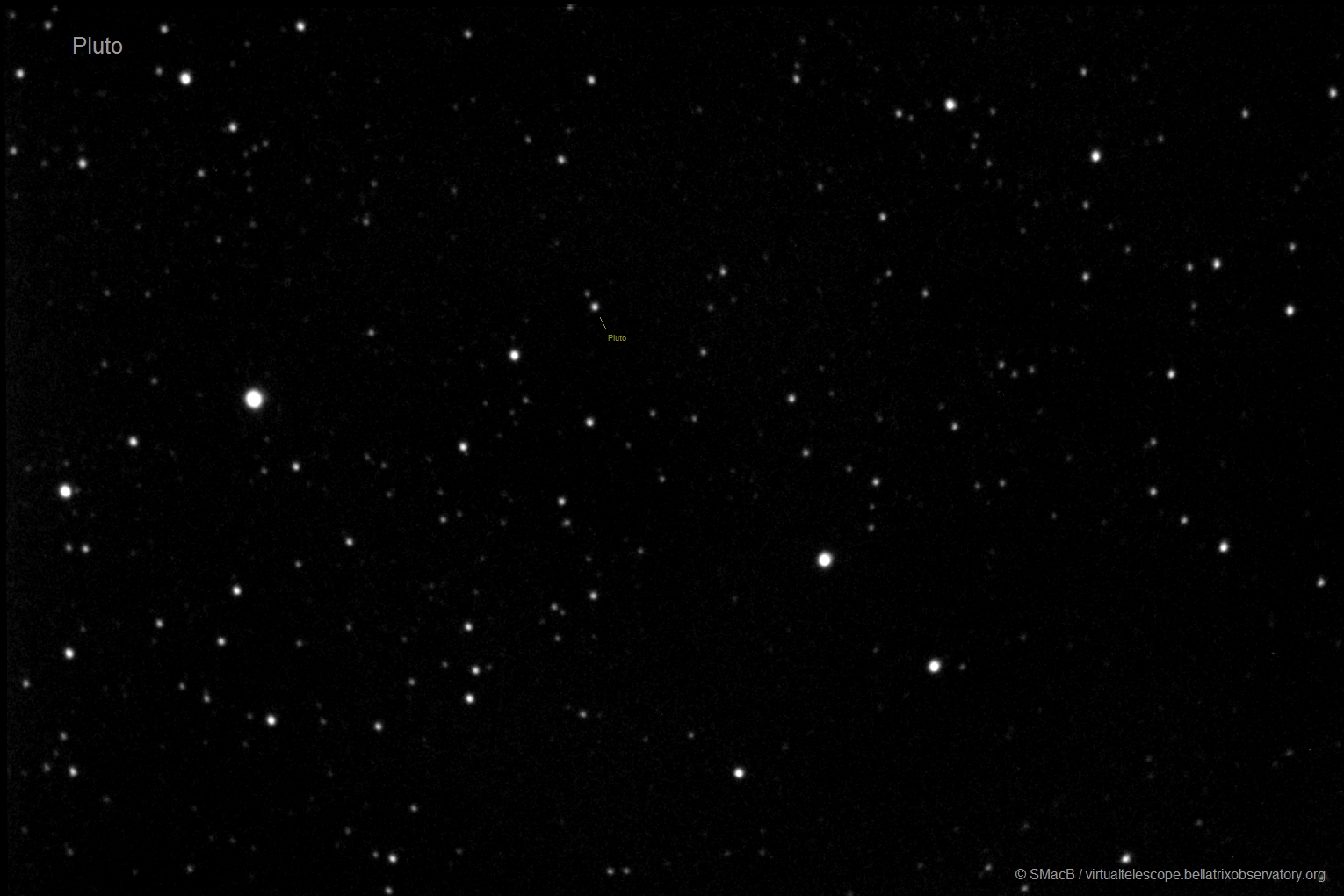
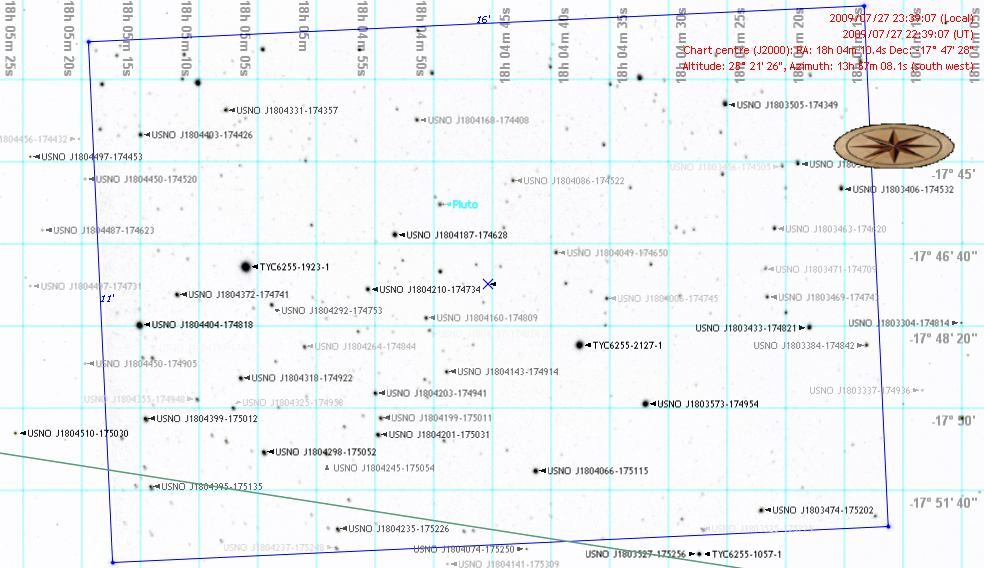
The original Bellatrix FITS data have also survived: