Structure / diagram
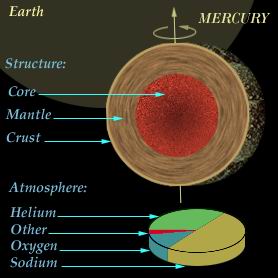
Planetary data
| Mean distance from Sun | 36 million miles (57.9 million km / 0.387 AU) |
| Distance range from Sun | about 29–43 million miles (47–70 million km) |
| Orbital period | 87.97 Earth days |
| Axial rotation | 58.646 Earth days |
| Solar day (sunrise to sunrise) | 176 Earth days |
| Orbital eccentricity | 0.206 |
| Orbital inclination | 7.0° |
| Equatorial diameter | 3,032 miles (4,879 km) |
| Mass (Earth = 1) | 0.0553 |
| Density (water = 1) | 5.43 |
| Surface gravity (Earth = 1) | 0.38 |
| Approx. surface temperature | −180 °C to +430 °C |
| Satellites | None |
| Rings | None |
Mercury commentary
Mercury
Mercury tends to be introduced as simply the planet nearest the Sun and then hurried past on the way to Venus. It deserves rather better than that. It is the smallest of the eight planets, only a little larger than our Moon, but it packs a surprisingly large metallic core into that small body and has an orbit and rotation unlike any other planet.
Being nearest the Sun does not make Mercury the hottest planet. That honour goes to Venus, whose dense atmosphere traps heat extremely efficiently. Mercury has almost no atmosphere at all, so although a sunlit surface can become hot enough to melt lead, the temperature falls dramatically after sunset. It is a world of extremes rather than one which is simply hot.
Orbit and rotation
Mercury races around the Sun in just under 88 Earth days, faster than any other planet. Its orbit is also noticeably elliptical: the distance from the Sun changes from about 29 million miles at perihelion to roughly 43 million miles at aphelion. That variation is substantial enough for the Sun to change visibly in apparent size during a Mercurian year.
The rotation is much slower. Mercury turns once on its axis every 58.646 Earth days and is locked into a 3:2 spin-orbit resonance: for every two journeys around the Sun it rotates exactly three times. The combination produces a solar day — noon to noon, or sunrise to sunrise — lasting 176 Earth days.
Near perihelion there is an additional oddity. Mercury moves around the Sun so quickly that, from some places on the surface, the apparent motion of the Sun can briefly reverse. An observer could see the Sun rise, stop, sink back toward the horizon and then rise again. It is a perfectly respectable consequence of orbital mechanics, although it would make a rather confusing morning.
Surface and geology
At first glance Mercury looks rather like the Moon: grey, airless and heavily cratered. The resemblance is genuine, but the details tell a more complicated history. There are ancient cratered highlands, smoother plains produced partly by volcanic activity, long cliffs known as lobate scarps, and enormous impact structures such as the Caloris Basin.
Those great scarps are especially interesting because they record the planet shrinking. As Mercury cooled, its interior contracted and the crust was forced to wrinkle and thrust over itself. The amount of contraction inferred from the surface is measured in kilometres of lost planetary radius, so the apparently dead landscape preserves evidence of large-scale changes deep inside the planet.
MESSENGER also found unusual bright depressions called hollows. They appear geologically young and seem to form where volatile material has been lost from the surface. Mercury may look thoroughly baked and battered, but it is not merely an inert copy of the Moon.
Interior and magnetic field
Mercury is unusually rich in metal. Its iron-rich core extends through roughly 85% of the planet's radius, leaving a comparatively thin rocky mantle and crust above it. Why Mercury ended up with such a large core is still an important question: ideas include unusual conditions during formation, the loss of rocky material in an early giant impact, or evaporation and chemical sorting in the hot inner Solar System.
Despite its small size and very slow rotation, Mercury possesses a global magnetic field. It is much weaker than Earth's and is offset northward from the planet's centre, but its existence shows that at least part of the core remains molten and capable of sustaining a dynamo. The resulting magnetosphere is small and is continually buffeted by the nearby solar wind.
Heat, exosphere and polar ice
With virtually no atmosphere to move heat around or retain it overnight, Mercury experiences one of the largest temperature ranges of any planetary surface. Daytime temperatures can reach about 430 °C, while long nights can fall to around −180 °C. The slow rotation makes both the heating and cooling periods exceptionally long.
Mercury does have an exosphere: an extremely tenuous cloud of atoms rather than a conventional atmosphere. Material is supplied by the surface through processes including solar-wind bombardment and micrometeoroid impacts. Sodium, oxygen, hydrogen, helium and potassium are among the species detected.
Perhaps the least intuitive feature of the planet is water ice. Mercury's rotational axis is almost upright, so the floors of some craters near the poles never receive direct sunlight. These permanently shadowed regions remain cold enough for substantial deposits of water ice to survive, despite being on the planet closest to the Sun.
Exploring Mercury
Mercury is awkward to reach. A spacecraft travelling inward from Earth gains speed as it falls toward the Sun, so simply getting there is not the difficult part — slowing down enough to remain there is. NASA's Mariner 10 made three flybys in 1974 and 1975, photographing part of the planet and confirming the existence of its magnetic field.
NASA's MESSENGER mission transformed our knowledge of Mercury. After a long series of planetary flybys it entered orbit in 2011 and spent more than four years mapping the surface and investigating the planet's composition, geology, magnetic field and exosphere. Among its major results was confirmation that the permanently shadowed polar deposits are dominated by water ice.
The next major investigation is ESA and JAXA's BepiColombo mission. At the time of this page update in August 2026 it is approaching the end of its journey, with Mercury orbit insertion scheduled for 21 November 2026 and routine science operations expected in 2027. Its two orbiters are designed to examine Mercury itself and the magnetic environment around it in considerably greater detail.
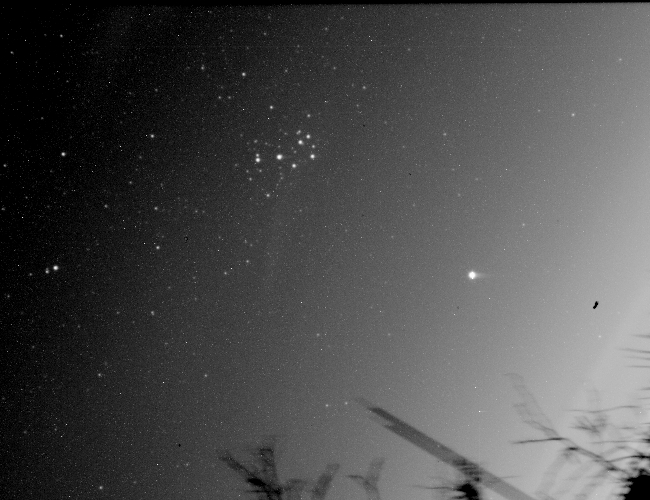
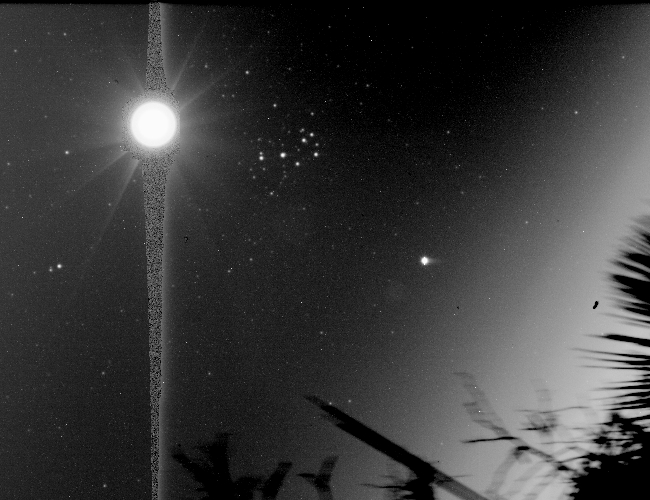
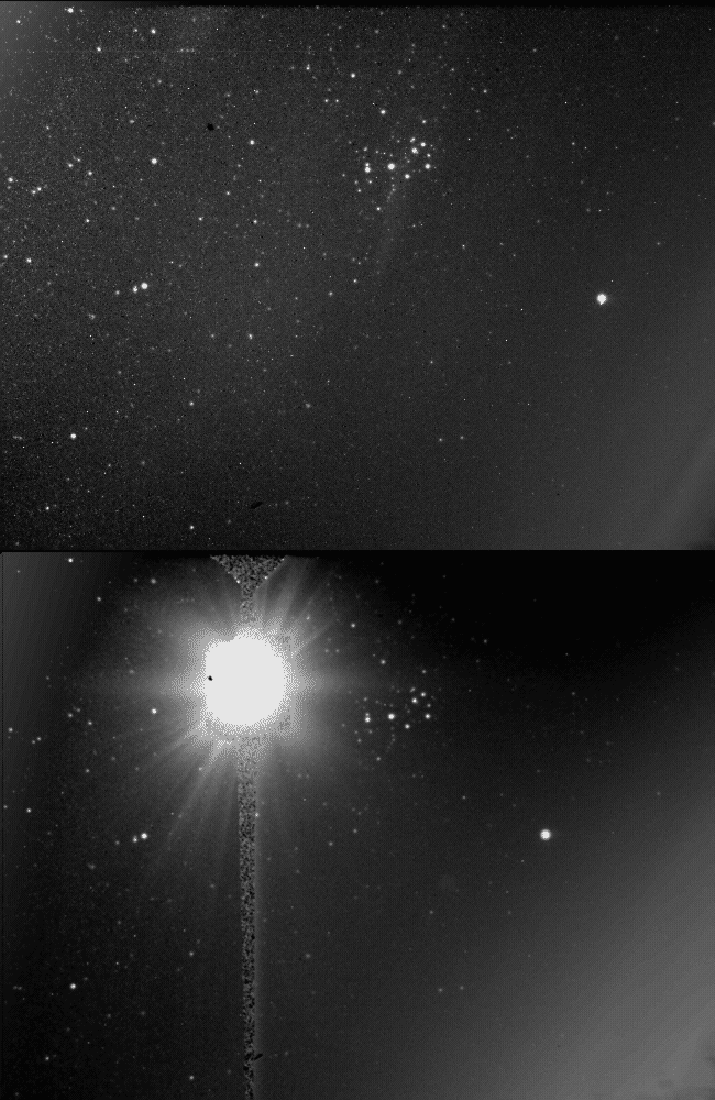
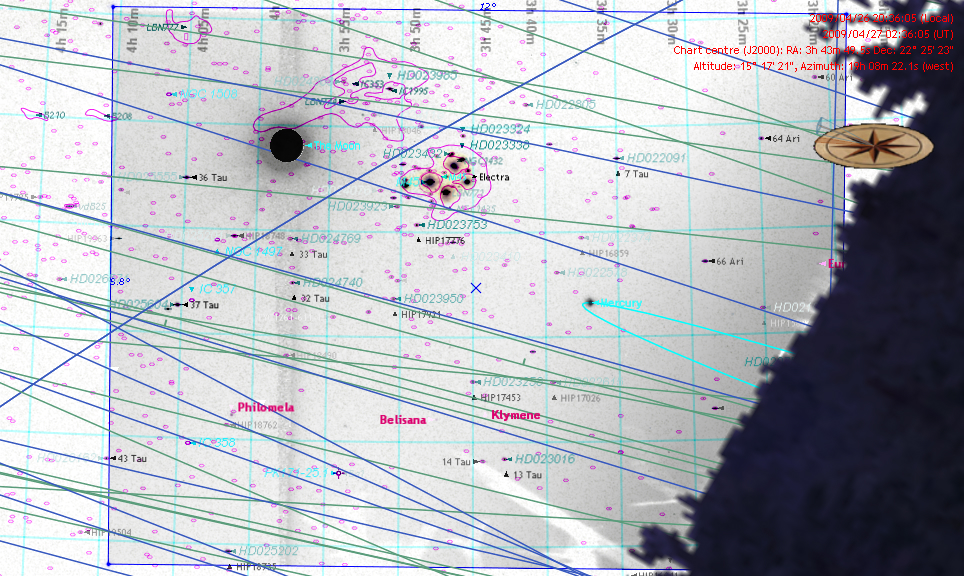
Mercury from my own archive
A few observations from near Amado, Arizona, in April 2009, when Mercury appeared close to the Pleiades in the evening sky. Mercury never strays very far from the Sun as seen from Earth, so catching it against such a familiar star field made this a particularly memorable apparition.