Beneath the clouds
Actually on Venus
Planetary data
| Mean distance from Sun | 67.2 million miles (108.2 million km / 0.723 AU) |
| Orbital period | 224.70 Earth days |
| Axial rotation | 243.0 Earth days (retrograde) |
| Solar day (sunrise to sunrise) | 116.75 Earth days |
| Orbital eccentricity | 0.0068 |
| Axial tilt | 177.4° (retrograde rotation) |
| Equatorial diameter | 7,521 miles (12,104 km) |
| Mass (Earth = 1) | 0.815 |
| Density (water = 1) | 5.24 |
| Surface gravity (Earth = 1) | 0.904 |
| Mean surface temperature | about 464 °C |
| Surface pressure | about 92 bar (roughly 90 times Earth sea-level pressure) |
| Atmosphere | about 96.5% carbon dioxide, 3.5% nitrogen, with sulfuric-acid clouds |
| Satellites | None |
| Rings | None |
Venus commentary
Venus
Venus is often called Earth’s sister planet, and at first glance the comparison makes sense. It is almost the same size as Earth, has a similar mass and density, and is made largely of the same sorts of rocky material. Put the two planets side by side, however, and the family resemblance becomes rather less comforting.
The surface of Venus is hotter than Mercury despite Venus being nearly twice as far from the Sun. Its atmosphere is enormously dense, the pressure at ground level is comparable to being almost a kilometre beneath Earth’s oceans, and the planet is permanently hidden beneath global clouds of sulfuric acid. Venus is a useful reminder that being Earth-sized does not necessarily mean being Earth-like.
Orbit and rotation
Venus travels around the Sun once every 224.7 Earth days and follows the most nearly circular orbit of any of the major planets. Its rotation, on the other hand, is decidedly peculiar. Venus turns very slowly and in the opposite direction from most planets, taking about 243 Earth days to complete one rotation relative to the stars.
That means a Venusian rotation is actually longer than a Venusian year. Because the planet rotates backwards while continuing to orbit the Sun, the interval from one sunrise to the next is shorter: about 116.75 Earth days. If you could somehow stand on the surface and see through the clouds, the Sun would rise in the west and set in the east.
Why Venus ended up rotating this way is still debated. Possibilities include large impacts early in its history and long-term tidal interactions involving the Sun and Venus’s dense atmosphere. Whatever the explanation, Venus has managed to turn something as apparently simple as “how long is a day?” into a question requiring three different numbers.
Atmosphere and climate
The atmosphere is dominated by carbon dioxide, with nitrogen making up most of the remainder. The lower atmosphere is so dense that carbon dioxide near the surface behaves more like a compressed fluid than the thin gas we are used to on Earth. Above this lie thick cloud decks containing droplets of sulfuric acid.
At the surface the pressure is about 92 bar and the temperature is roughly 464 °C. There is very little difference between day and night temperatures because the massive atmosphere stores and circulates heat extremely effectively. High in the atmosphere the situation changes dramatically: temperatures and pressures become much more Earth-like, although the chemistry remains distinctly unfriendly.
The upper atmosphere also races around the planet far faster than the solid surface below. Cloud-top winds can circle Venus in only a few Earth days, a phenomenon known as atmospheric super-rotation. Exactly how such a slowly rotating planet maintains such a rapidly moving atmosphere remains an active subject of research.
Why Venus is so hot
Venus is the clearest natural example we have of an extreme greenhouse climate. Sunlight penetrates the upper atmosphere and clouds, warming the surface and lower atmosphere. The enormous quantity of carbon dioxide then absorbs outgoing infrared radiation and makes it very difficult for that energy to escape to space.
The result is not simply “a stronger version of Earth’s greenhouse effect”. Venus has reached a state in which the whole lower atmosphere is extraordinarily hot and dense. Any oceans the young planet may once have possessed are long gone. Water vapour reaching high altitudes would have been broken apart by ultraviolet sunlight, with hydrogen escaping to space and leaving the planet progressively drier.
Venus therefore provides an important comparison with Earth and with rocky planets around other stars. Two worlds of similar size and basic composition followed radically different climatic paths, and understanding exactly when and why they diverged is one of the central questions of Venus science.
Surface and geology
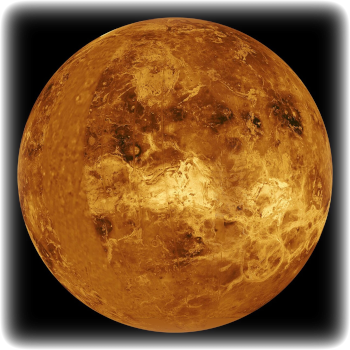
Visible-light cameras cannot see the surface through the clouds, so much of our global knowledge comes from radar. NASA’s Magellan spacecraft mapped almost the entire planet in the early 1990s and revealed vast volcanic plains, mountain belts, enormous shield volcanoes, strange circular structures called coronae, and highly deformed highland terrain known as tesserae.
Venus does not appear to have Earth-style plate tectonics with a collection of large, continuously moving plates. Instead its crust may deform and recycle material in other ways. Evidence accumulated from Magellan data also suggests that Venus is volcanically active today, or at the very least has been active extremely recently in geological terms.
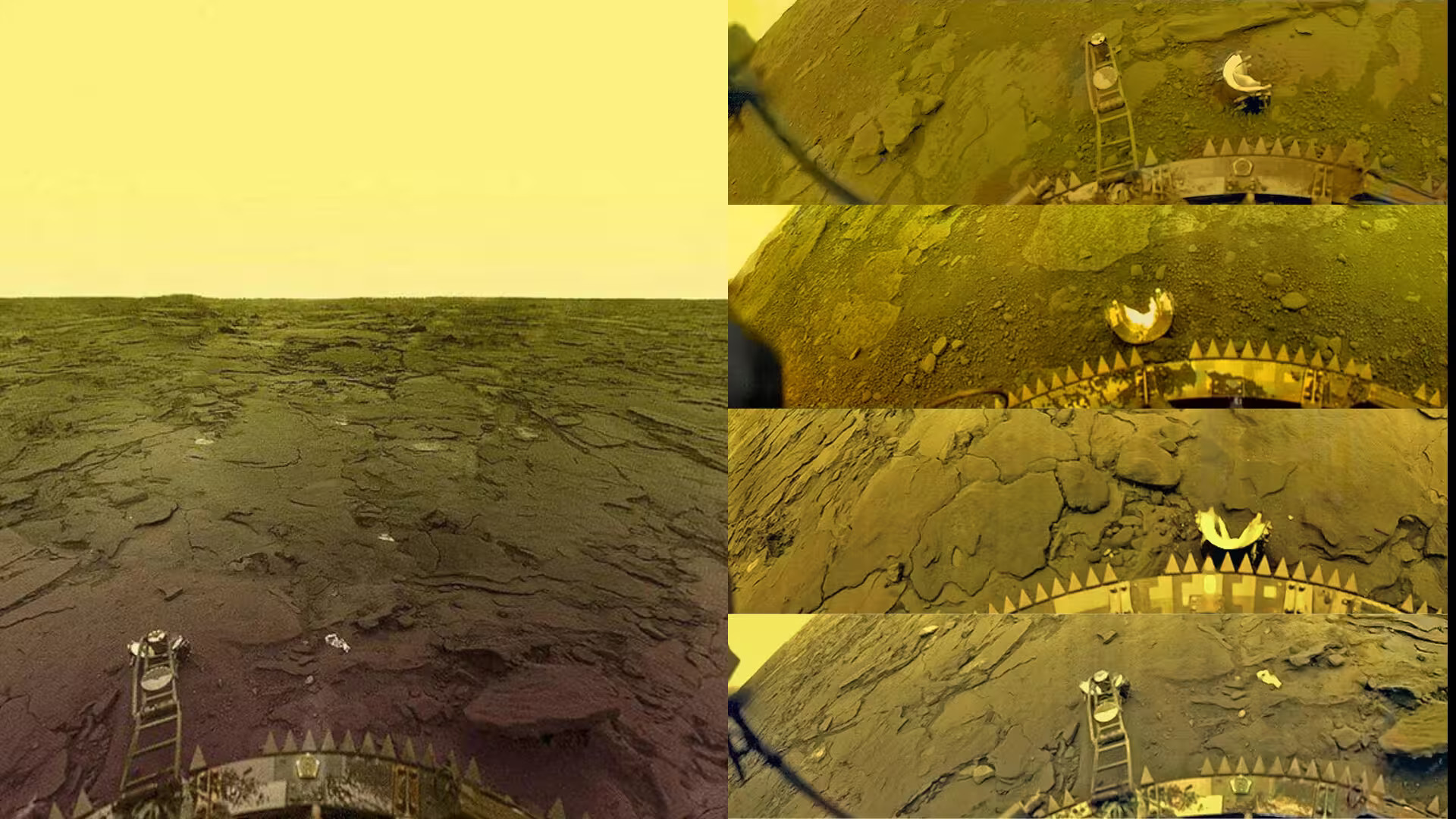
The surface itself has been visited. Soviet Venera landers survived the descent and transmitted measurements and photographs from the ground, although the combination of heat and pressure limited their lives to minutes or, in the best cases, a little over two hours. Building something that can operate for long on Venus is less a matter of “landing” and more a matter of arranging for electronics not to become soup.
Scientific bunfight: phosphine, clouds and the possibility of life
In 2020 a team of astronomers reported an apparent detection of phosphine in the atmosphere of Venus using the James Clerk Maxwell Telescope and ALMA. Phosphine attracted immediate attention because on Earth it can be associated with biological activity and because known chemical processes did not obviously explain the originally reported abundance.
Then came the scientific bunfight. Re-processing of the ALMA data reduced the inferred abundance, independent teams questioned whether the signal was statistically significant, and sulfur dioxide — a thoroughly Venusian molecule — became part of the argument over the interpretation of the spectral line. The original team continued to argue that at least some of the observations are consistent with phosphine, while other analyses have found no convincing detection.
There have since been further reports of possible phosphine and ammonia signatures, including suggestions that the abundances might vary with time and location. That is interesting, but it is not evidence that Venus is inhabited. The clouds are extraordinarily acidic and the amount of available water is tiny, both of which present formidable problems for anything resembling terrestrial life.
The sensible conclusion at present is therefore wonderfully unsatisfactory: something interesting may be happening in the chemistry of Venus’s clouds, but phosphine itself remains disputed and there is no confirmed evidence of life. Which, of course, is precisely why people keep arguing about it and why actually sending instruments into the clouds would be considerably more useful than another decade of shouting at spectra.
Exploring Venus
Venus has a distinguished history of spacecraft exploration. Mariner 2 made the first successful planetary flyby in 1962. The Soviet Venera programme later achieved the first successful transmission from the surface of another planet and eventually returned the only photographs ever taken from the surface of Venus. NASA’s Magellan then used radar to map the planet globally through the clouds.
A new generation of Venus missions is being prepared. NASA is developing DAVINCI to study the atmosphere in detail during a descent through the clouds, and VERITAS to investigate the surface and interior using radar and spectroscopy. ESA’s EnVision mission is also in development and is currently planned for launch in November 2031, with a broad investigation extending from the planet’s interior to its upper atmosphere.
Together these missions should address several of the questions that make Venus so interesting: whether it once had oceans, how recently its volcanoes have erupted, how its surface is being reshaped, how the atmosphere and interior interact, and exactly how an apparently Earth-like starting point produced the hottest planetary surface in the Solar System.